
The Brexit naturalisation effect, ten years on
What several hundred thousand citizenship decisions reveal about the value people place on EU citizenship — once it is taken away

Ten years ago today, on 23 June 2016, a narrow majority of British voters - 52 per cent - chose to leave the European Union, and with it to give up the EU citizenship that had come automatically with their British nationality.
A survey by the European Council on Foreign Relations finds that two-thirds of EU citizens would now back the UK rejoining, while three-quarters of British voters want a closer relationship - including freedom of movement, the issue that once defined the Leave campaign.
But while it remains to be seen how the relation between UK and the EU will develop, in the years after the referendum, several hundred thousand people on both sides of the Channel went out and acquired a new citizenship. So people acted by themselves, repairing the Brexit damage where they could. For citizenship and data geeks such as myself, the referendum is about as clean a natural experiment as the messy world of migration data is ever likely to offer. And ten years after the referendum, what better moment to dig into the data, make a few nifty graphs, and take stock of the long-term Brexit naturalisation effect?
A word on what was at stake. At the time of the referendum, roughly 1.2 million British nationals were living in other EU member states, and roughly 3.2 million non-Irish EU citizens were living in the UK. For the British, the vote meant the prospective loss of the right to live, work and study across the continent. For EU citizens in Britain, it put settled lives into question. So this was always going to be a two-sided story, and I look at both sides in turn. The most telling result, it turns out, is not the British surge on its own but how lopsided the two responses proved to be - and why.
How many British nationals took up another European citizenship?
Let’s start with the British in Europe. Between 2008 and 2015, an average of about 2,558 British nationals naturalised each year across the 30 European countries I look at - the 27 EU member states plus Iceland, Norway and Switzerland (the last three do not restore EU citizenship as such, but they preserve most of the mobility that comes with it). After 2016 the number broke sharply upward. 2019 was the peak year, with more than 30,000 British nationals taking another European citizenship in a single year. Between 2016 and 2024, well over 130,000 did so.
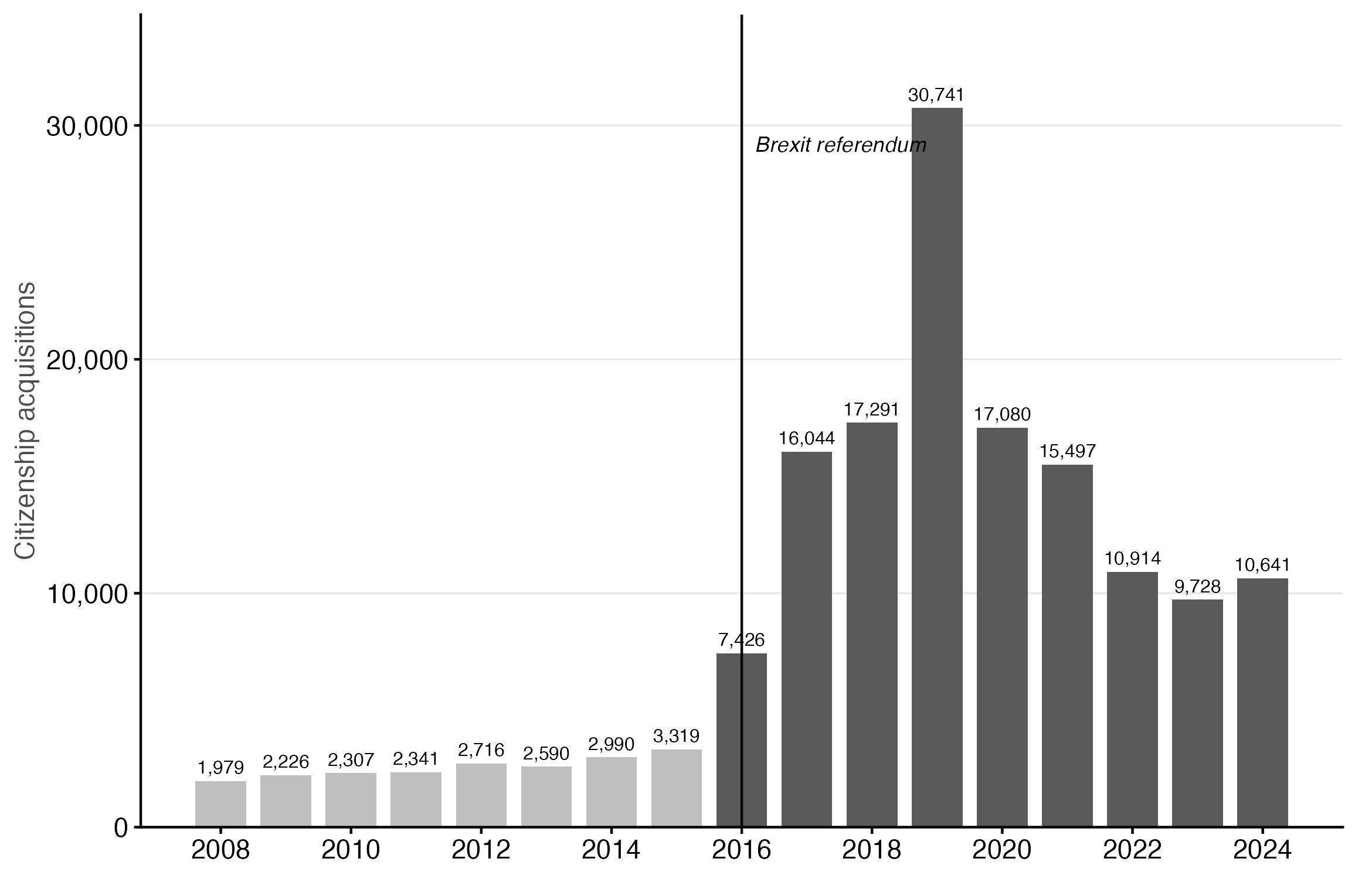
Figure 1. Total citizenship acquisitions by British nationals in 30 European countries, 2008–2024. Source: Eurostat.
But is this really a Brexit effect?
A jump after 2016 is suggestive, not conclusive. Naturalisations might have been rising everywhere, for reasons unconnected to Brexit. To pin the effect on the referendum, I need a comparison group: people naturalising in the same countries, in the same years, but who were not hit by the vote.
The natural comparison is other Europeans. So I compare the before-and-after change among British nationals with the before-and-after change among citizens of those same 30 countries naturalising in one another’s states, using the difference-in-differences estimator of Callaway and Sant’Anna. The logic is simple: before 2016 the two groups tracked each other closely; if they then diverge, the gap is the Brexit effect. (I work with the absolute number of naturalisations, which captures the scale of the response; the technical detail, including a version based on naturalisation rates, is in the draft chapter on which this post is based. See the link at the end.)
And they do diverge. The estimate is that Brexit produced about 11,000 additional British naturalisations a year across these countries. Over the nine years from 2016, that comes to roughly 100,000 British nationals who acquired the citizenship of another European country and who, on the evidence of the earlier trend, very likely would not have done so otherwise.
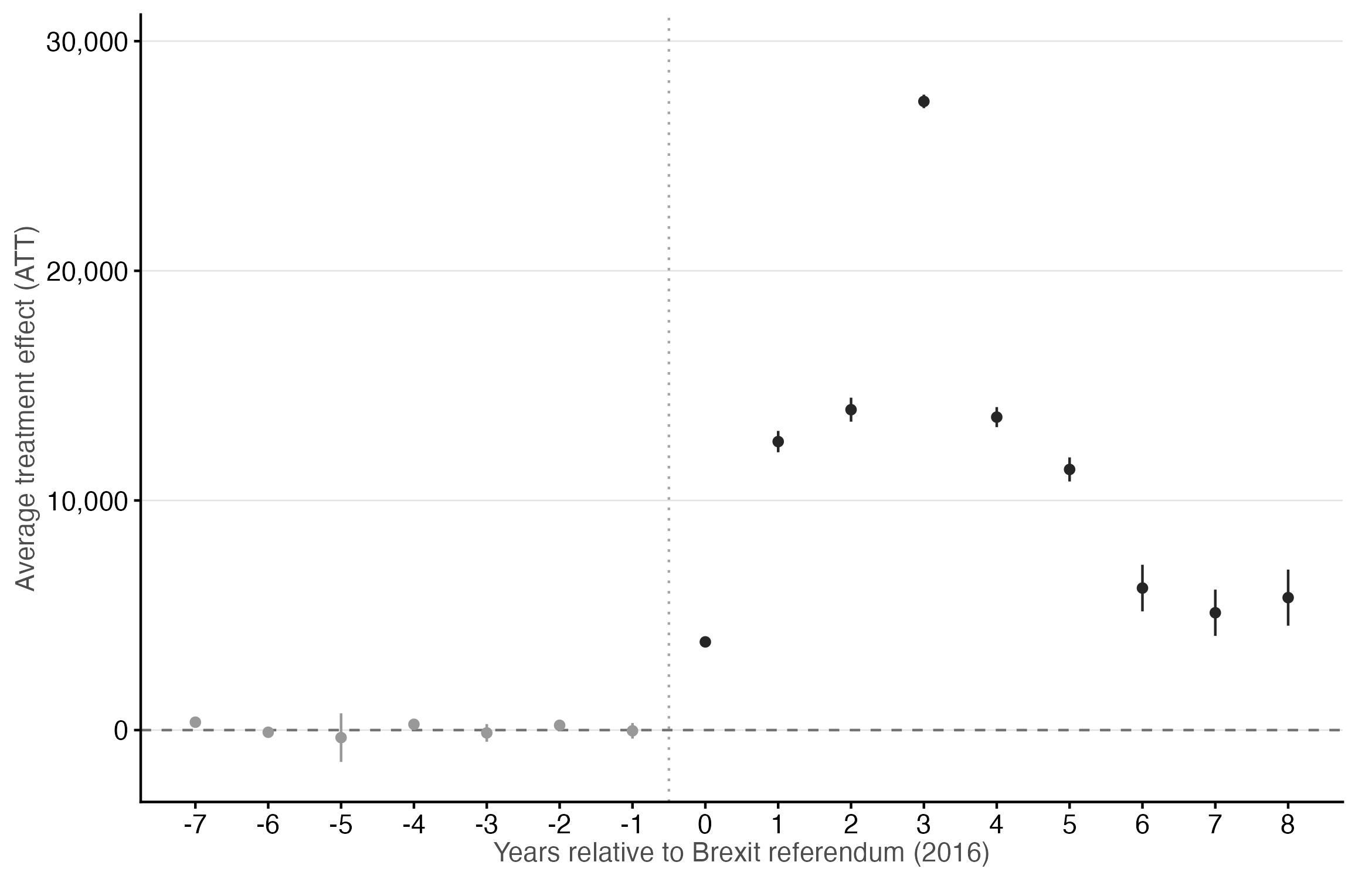
Figure 2. Difference-in-differences event study: the estimated Brexit effect on citizenship acquisitions by British nationals, by year relative to the 2016 referendum. Source: Eurostat; Callaway and Sant’Anna (2021).
Because there is only one treated group here - the British - I checked the result the way synthetic-control studies do, by pretending in turn that each of the other 30 nationalities had been the one hit by Brexit. The British effect comes out larger than all of them; a jump this size would arise by chance about one time in thirty. If you’re curious, that test is in the pre-print too.
Where did they go, and why there?
The British did not spread evenly across Europe. Just over half - 53 per cent - of all post-referendum naturalisations happened in only three countries: Germany (up to 37,000), France (about 23,000) and Sweden (about 11,000).
Why these three? Population size and economic pull play a part, but dual citizenship is, I suspect, the bigger factor. France and Sweden do not ask naturalising citizens to renounce their existing nationality, and Germany exempted other EU citizens from its renunciation requirement (until it ‘modernised’ its citizenship law in 2024 and allowed dual citizenship generally). Where dual citizenship was harder, take-up lagged: in Norway, British naturalisations only really picked up once it allowed dual citizenship in 2020; in Austria, the rise came in 2021, through a route for the descendants of those persecuted by the Nazi regime, which does not require giving up another passport. The pattern fits something well established in research on naturalisation - people reach for a second citizenship far more readily when they do not have to surrender the first.
What about the other side of the Channel?
Brexit was not only a British story, and the data show EU citizens in the UK answering the same question. Naturalisations by EU citizens broke upward in 2016, climbed steeply, peaked at about 67,000 in 2021, and have stayed historically high since - still above 60,000 in 2024, far above the roughly 13,000 a year seen before the referendum. Polish, Romanian and Italian nationals account for much of the increase, reflecting both the size of those communities and their propensity to naturalise.
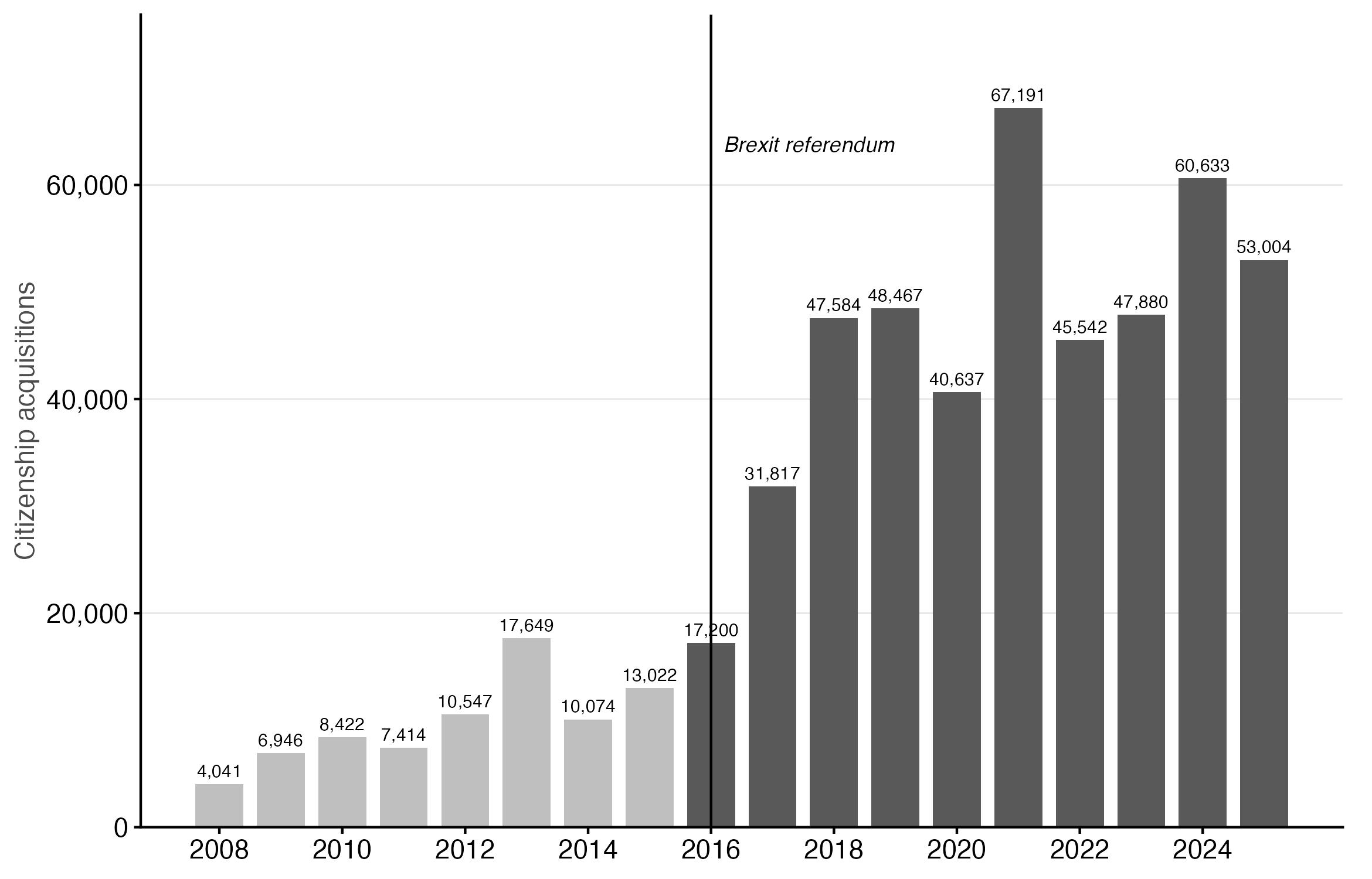
Figure 3. Total citizenship acquisitions by EU citizens in the UK, 2008–2025. Source: UK Home Office.
So why was the British response so much bigger?
This contrast is the crux of the story. Run the same difference-in-differences analysis on the UK side - EU citizens as the treated group, non-EU nationals as the comparison - and the Brexit effect is real and clearly significant, but far smaller: about 1,000 additional EU-citizen naturalisations a year, against 11,000 on the British side, and some 10,000 over the period. That is roughly a tenth of the British effect; and because there were nearly three times as many EU citizens in the UK as British nationals in the EU, the gap per person is starker still - on a per-capita basis, the British naturalised at something like thirty times the rate. So why was that?
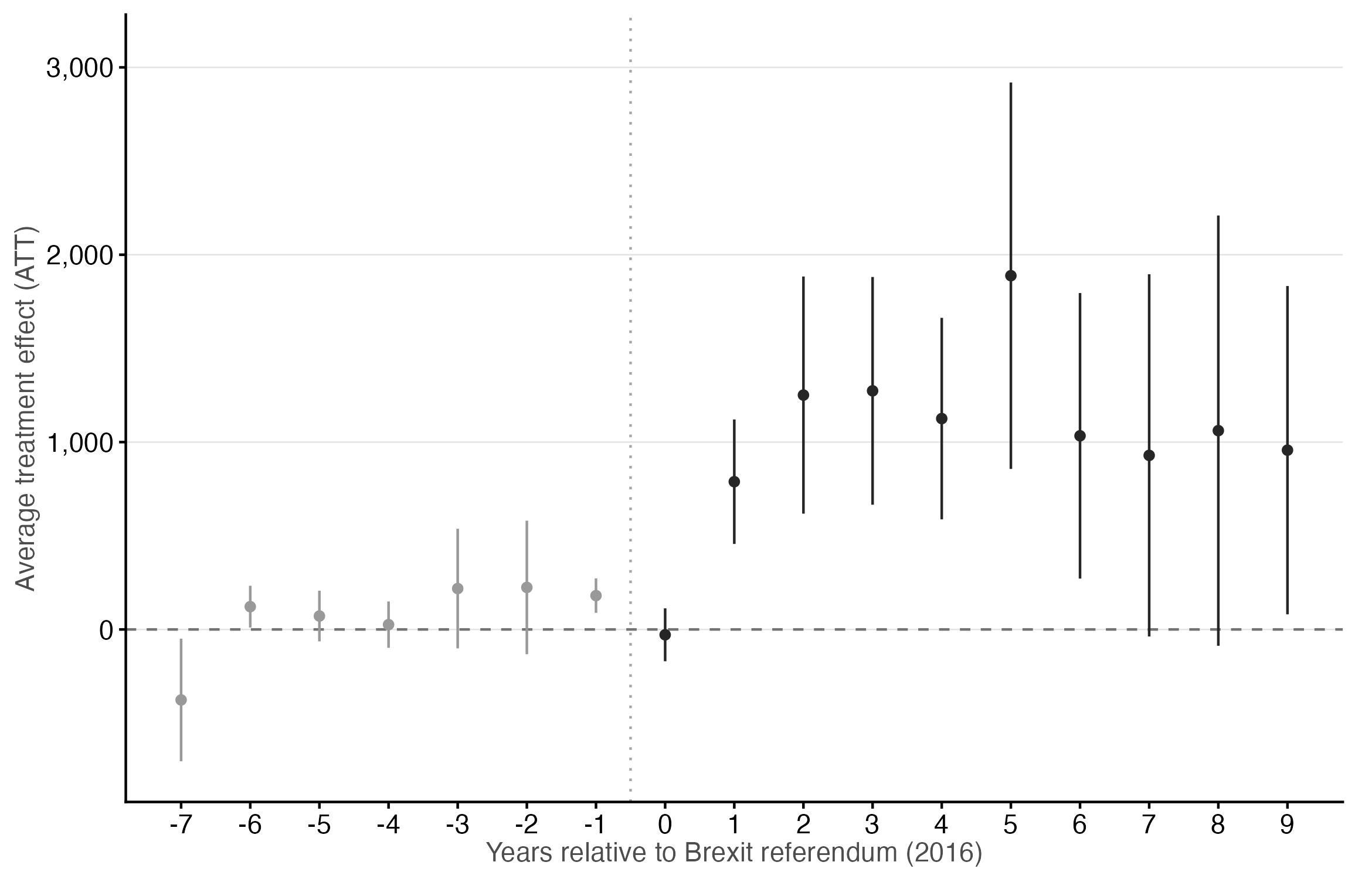
Figure 4. Difference-in-differences event study: the estimated Brexit effect on citizenship acquisitions by EU citizens in the UK. Source: UK Home Office; Callaway and Sant’Anna (2021).
The heart of it is that EU citizens in the UK had an alternative that British nationals in the EU largely did not. Through the EU Settlement Scheme, EU citizens lawfully resident before the end of 2020 could secure settled status and retain most of their everyday rights - to live, work, access public services and travel in and out of the UK - without taking the larger step of naturalising. British nationals in the EU had no single equivalent. Withdrawal Agreement residence schemes existed, but they were implemented country by country and protected rights only in the particular host state where someone lived, not the EU-wide freedom of movement that had come with EU citizenship. British nationals also generally lost EU-citizen electoral rights, including the right to vote in European Parliament elections and, depending on the member state, municipal elections, unless they held another member state’s nationality or benefited from a specific reciprocal arrangement.
So, for a British national who wanted EU-wide rights back, naturalisation in an EU member state was the only real route. An EU citizen in Britain, by contrast, could cover much of their post-Brexit exposure through settled status, which plausibly took much of the urgency out of naturalising. Where each group started mattered too: before Brexit, EU citizens in Britain barely naturalised at all - free movement gave them little reason to - so even a sharp proportional rise from that low base translated into fewer passports than on the British side. Having said that, the gap may yet narrow. Naturalisation by EU citizens in the UK rose sharply after Brexit and was still high in 2024, suggesting that settled status may be working, for many, as a staging post rather than a permanent substitute for a passport. A recent study by Catherine Barnard and Fiona Costello on EU citizens in Great Yarmouth shows what this looks like on the ground: EUSS status secures many everyday rights, but for some EU citizens the question of British citizenship remains open, shaped by security, pragmatism, cost and language requirements.
What does it all mean?
Two-thirds of EU citizens say they would welcome the UK back; three-quarters of British voters now want closer ties. The naturalisation figures are not what people say about EU citizenship, but what they were willing to pay - in fees, language tests, residence requirements and a good deal of paperwork - to keep it. Many acted within months of the vote, years before the UK actually left.
And the full count is larger than the figures so far. The Eurostat data only capture people who naturalised where they live, so they miss the roughly 120,000 British nationals who have claimed Irish citizenship since 2016 through a grandparent or parent, on Ireland’s Foreign Births Register. Add those, and the British side alone passes 220,000; add the UK side, and the two-sided Brexit citizenship response runs to well over 200,000 - on the order of 230,000 - new citizenships in all. Set against the roughly 60 million people who lost EU citizenship overnight when the UK left, that is a small fraction. But it is a revealing one.
It is tempting to read Brexit as confirmation that, in the end, what counts is the nationality of a member state rather than the more abstract status of EU citizenship. On one level, yes, you could keep EU citizenship only by holding the passport of a member state, and the British had no way to hold it directly. But look at what people were actually chasing. It was not German or French or Irish nationality for its own sake; it was the bundle of rights that EU citizenship carries. The member-state passport was the means; EU citizenship was the end.
It is also an instance of what the sociologist Yossi Harpaz has called “compensatory citizenship”- acquiring a second nationality to secure rights and options the first cannot provide. And it happened to holders of a British passport, one of the strongest in the world. Even from a position of global privilege, losing a regional bundle of rights was enough to send people looking for a second citizenship.
One last point, easily lost in the totals. This was an uneven response. The people best placed to turn a legal opportunity into a restored status - those with the right ancestry, the residence history, the information and the resources - were often those least exposed to the loss in the first place. Research on naturalisation consistently finds that the better-educated and better-off are the most likely to naturalise, and there is little reason to think Brexit was an exception.
Brexit, then, did not show that European citizenship was fading. It showed, in several hundred thousand quiet and costly decisions, how much it was worth to the people who stood to lose it.
The figures in this post can be reproduced with the code and data in my GitHub repository: github.com/maarten-vink/brexit-naturalisation-effect. A pre-print of the full chapter is available here: https://osf.io/dktj4/files/r5e72.
How to cite this post: Maarten Vink, “The Brexit naturalisation effect, ten years on”, maartenpvink.substack.com, 23 June 2026.
Ottimo!, really interesting analysis Maarten! 👏 Grazie mille! Especially, the data on the top 3 countries Brits claimed secondary citizenship.
How delightful to read the statistical and social story on the value of EU citizenship. I clearly see the echos of my personal decisions, effort and investment in becoming Portuguese. Language tutoring in 2016, then all the coordinated bureaucracy to apply in 2017, with approval in 2021. - Thank you for illustrating the bigger picture.